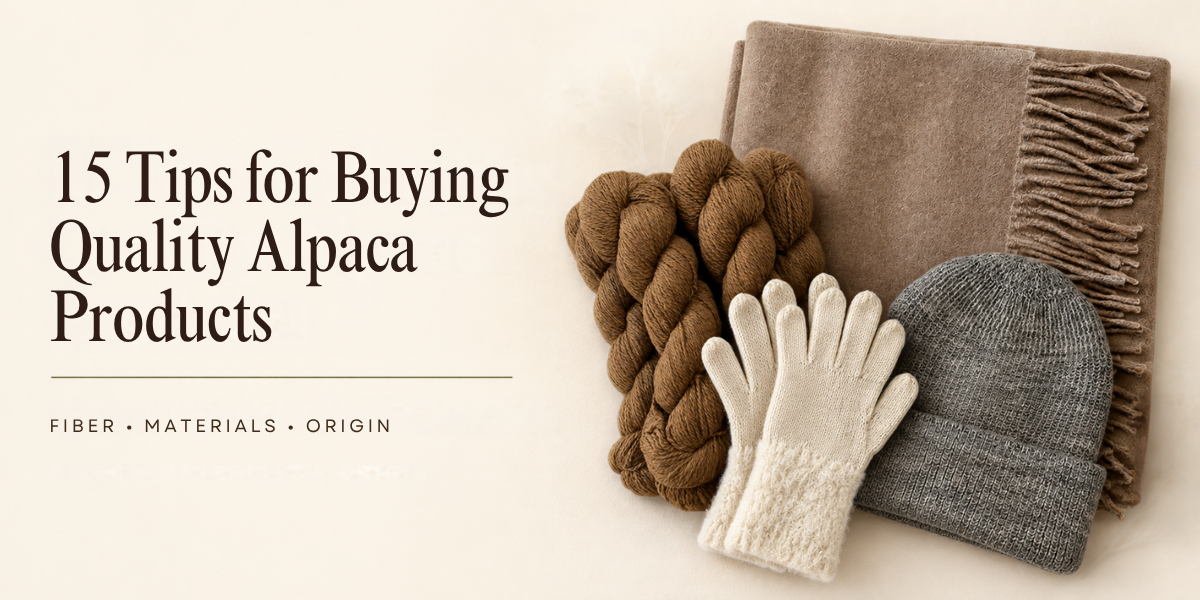
If you’ve ever been to Peru, or even a USA alpaca farm, you know it is easy to get caught up love of the animals and make impulse purchases. While alpacas are adorable, alpaca products are amazing and they offer a large list of desirable characteristics. They’re also a great “buy it for life” item if you purchase the right product.
Not all alpaca products are equal in quality and value. Before you pull out your credit card, I want to walk through some important tips and information tidbits to help you evaluate and buy the right item.
1. Watch for Unisex Sizes
The majority of alpaca products are unisex, so your ideal size may not be what you’re used to when shopping. This is especially true in alpaca socks, hats, sweaters. Product descriptions should have dimensions or guides for selecting the right size. For socks, there should be a table that compares women’s and men’s shoe sizes to the corresponding sock size. Keep an eye out for these guidelines, and don’t skip this step, or you’ll end up returning an item because it doesn’t fit.
2. Know the Level of Warmth Needed
A product’s level of warmth is often described as lightweight, midweight, or heavyweight. Lightweight is great for indoor areas, southern states, or spring, summer, and fall wear. Midweight is great for fall, winter, or spring and it can accommodate a wide range of climates. Heavyweight is great for the heart of winter and colder U.S. states. We offer a variety of weights because we sell products all over the country and for year round usage. Know the weight you need for your geographic area and time of year, so the purchase aligns with your expectations.
3. Remember That When it Comes to Alpaca, Thin Doesn’t Mean It Lacks Warmth
Because alpaca fiber is so much warmer than other products, it is many times used to create thinner products. Brushed alpaca throws are a great example of this application. You really can have a lightweight, thin alpaca throw that is warm and snuggly. I’ll admit the first time I used one, my mind struggled to match up the thin material to the level of warmth I felt on my body. I was used to acrylic or polyester blankets where you needed a lot of loft for warmth. You don’t with alpaca, so don’t shy away from thinner throws that are 100% alpaca. They will be warm and they make great options for curling up with a book or watching TV.
4. Pay Attention to Fiber Grades
Alpaca products should have a fiber grade listed. This will be based on grade (one, two, three, etc.) or terms like royal, baby, superfine. Fiber grade indicates the micron level of the fiber used, which is a important calculation for determining the softness of the product and the appropriate usage of the fiber. I’ve already written a blog post on alpaca fiber grades, so you can read more about fiber grades in this article. As you shop, look for fiber grades. If you’re purchasing an item that will be close to your skin, be careful purchasing items that do not disclose this data.
5. Look for Material Lists and Percentages
A quality alpaca store will clearly list a product’s materials and percentages of each. This is important to read and consider. There are lots and lots of products marketed as “alpaca products” that include only a small portion of alpaca (like 10% or 20%). A throw with 20% alpaca and 80% acrylic is not going to be the same quality or warmth as a throw made from 100% alpaca.
As sad as it is to say, many online sellers omit information to capture impulse buys. Don’t fall into that trap. And be extremely careful with websites like Amazon, Etsy, and Temu. All three are known for marketing products as alpaca, when they carry very little or even no alpaca. Don’t waste your money on these products!
6. Watch Out for Excessive Brightness
While some alpaca fiber can naturally be very bright and luxurious looking, overly bright products can be an indication of acrylic. I’ve encountered alpaca throws that state they are 100% alpaca, but when you look closely you can see they are brighter than they should be. As you feel the throw it is becomes even more apparent that the composition isn’t what is claimed and it is actually a mix of alpaca and acrylic, that is heavy on the acrylic. Be on the look out for garments that seem overly bright. It could very well mean the product has synthetics mixed in and the manufacturer isn’t disclosing it.
7. If Origin Matters, Check Your Labels Closely
“American made” is all the rage and I love the fact that we are doing our part to produce USA knit alpaca products. You need to keep in mind that “made in the USA” can mean different things to different sellers.
There are lots of sock manufacturers that claim to sell USA made socks, but in reality, the socks are really just knit in the USA with Peruvian fiber. Do you consider these socks to be USA made or Peruvian made? If you’re shopping online for alpaca socks and you see made in the USA with no mention of yarn origin, be suspect.
Another discussion point is the state of the textile industry here in the USA. There are lots of alpaca items we cannot make in America because we no longer have the infrastructure in the USA to run the products. Most textile manufacturing left America decades ago and the machinery no longer exists. To make matters worse, existing commercial fiber mills and processing facilities are going out of business at an alarming rate. This makes it impossible for an alpaca seller to make all their products locally. Expect gloves, sweaters, ponchos, capes, felted vests, throws, and duvets to originate in Peru. All of these items are virtually impossible to produce in the USA.
On our farm we make what we can in the USA and we use a few select Peruvian partners for items that simply cannot be produced in the USA. We disclose origin in product descriptions so keep an eye out for this datapoint if made locally is important to you. If you see a product without this information, it simply means it is an older item and I haven’t backtracked to fill the data in.
Another datapoint to know is pretty much all fur products originate in Peru. This includes stuffed animals and fur pillows. These products use animal hides and they are made from natural loss of animals in Peru. Peru has a much higher mortality rate than in the USA, so they have the materials naturally available for these items. And before you feel off put by this knowledge, know the purchase of these goods help poor families across Peru to obtain some financial benefit from the loss of their livestock. It allows a little good to come from sadness.
8. Know That Made in the USA Will Be Higher in Cost
As we discussed above, it is really hard to manufacturer alpaca products in the USA. We have less options, lesser capabilities, and higher labor rates. Our cost basis is a lot higher for all things and there is no getting around it. There is no way a made in the USA item can compete with Peru on pricing.
If made in the USA matters, you need to level set your expectations and know these locally made goods will cost more than an imported item.
9. Remember That Made in Peru Doesn’t Mean Less Quality
A few years ago my husband and I spent two weeks in Peru and we were fortunate enough to meet with manufacturers and tour their production facilities. I was so impressed with these production facilities, their capabilities, their quality control, and the professionalism displayed. From multigenerational knowledge and craftsmanship to product specifications and ongoing quality checks, Peru has the best manufacturing capabilities in the world for alpaca yarn and products.
Now that said, not all Peruvian products are of quality. There are many sellers that offer products of lesser quality or misrepresented. You have to be careful because not all products coming out of Peru are the same.
Let me tell you a little secret – most quality products from Peru will originate from yarn made by three providers. Just three companies. But these brands hold high standards for quality, they test fiber to validate grade, they are stringent for quality, and they are fair trade certified. We make sure any items we import originate from one of these companies, so we can guarantee quality.
10. Limited Availability is a Way of Life, So Adjust Buying Habits
One of my biggest frustrations in running an alpaca based business is the inconsistent inventory levels we have to carry. And there is no getting around this since we work with natural products with natural colors.
While we do collect fiber from other farms in the USA to make products, this available fiber changes each year based on the “clip” (aka fiber sheared off the animals). Sometimes we can have a big, beautiful batch of silver grey fiber and others have very little grey. This limits what we can make from the yarn spun from this raw fiber. And it isn’t just our farm in the USA. I’m sure Peru deals with the same issues and it is a primary reason why they dye raw white fiber.
If you encounter this issue as a product buyer, know it isn’t created by choice. Also know it is wise to buy multiple items of something you love, because you don’t know when that color or size will be back available.
11. Traceability is a Bit Fluid, So Expect This When Shopping
While I can tell you what farms we collected raw fiber from in each year and what raw fiber made it’s way into a given product, I cannot tell you if the black dryer ball you received came from an alpaca named Stormy or Bean. I’ve been asked that last part often, because well, Stormy and Bean were two adorable and lovable black alpacas we owned and everyone wanted their products.
There is a lot we can trace throughout the supply chain, but we do hit limits.
We know people love to know the exact alpaca their shawl came from and we can offer this information if we ran a small batch of yarn by animal and then hand that yarn over to a knitter to knit a few shawls from it. In certain products this is feasible, albeit expensive.
In products like socks, where we produce thousands a year, we cannot get to that granular level because we have to pool large amounts of fiber together to make a batch of sock yarn. This isn’t a choice, it is a necessity.
So yes traceability is important and we do have systems in place to track fiber movement. But know I cannot promise Bean’s black fiber made it’s way intoi the pair of socks on your feet.
12. Sustainability Can Only Go So Far, So Please Understand Our Constraints
Alpaca is sustainable, but that doesn’t mean we can go 100% natural all the time.
We need acrylic, nylon, or other materials for socks to stay up on your leg and be durable enough for work wear. This isn’t done to cheapen the product or reduce costs, it is done to create a high quality product you can wear for years.
We do use dye on some products and this is because consumers demand it. I absolutely love the natural colors alpaca fiber comes in and we use as much natural colors as possible. That said, some people want vibrant colors (like blue, purple, red, pink) and the only way to achieve this is to dye white fiber. I’ve had website visitors scold me for this practice, and in doing so, claim that we are “whitewashing” our sustainabilities claim. While they are allowed their opinions, we are not lying and we try and disclose as much as possible even if we risk overwhelming people with too much information. The bottom line is alpacas don’t come in purple, red, or blue so the only way to meet consumer demand here is to utilize dyes.
Sustainability is an honorable pursuit and one we take seriously. We promise we will do everything we can to utilize as much of the fiber as possible, avoid chemicals, and reduce our carbon footprint. Thankfully, the alpacas are highly sustainable animals and they do most of the sustainability work for us.
13. Expect Color Variations – They’re a Common Output of Natural Yarns
Alpacas come in sixteen primary colors that including white, beige, light fawn, medium fawn, dark fawn, light brown, medium brown, dark brown, bay black, true black, light silver grey, medium silver grey, dark silver grey, light rose grey, medium rose grey, and dark rose grey. There are also many variations of these and patterns that can exist, so not all alpacas will fall entirely into a solid color.
You’ll find alpacas will spots, you’ll find alpacas where their fiber tips out to another color, and you’ll find alpacas with color contamination (an example is white mixed into a dark grey). This is all natural and it will find its way into products that use undyed alpaca fiber. This isn’t a flaw, it is the standard presentation of natural products made from real animal fur.
As you browse products or you review your newly arrived purchase, keep these color variations in mind. It doesn’t mean that your fur scarf is dirty, it simply means that alpaca had variations in their coat.
14. Know That Small Batch Products Will Have Inconsistencies
When a clothing brand creates products in polyester and at a commercial level, their products will be very consistent because the raw materials and manufacturing process is uniform. Alpaca is anything but.
Alpaca fiber has different colors, different crimp structure (the tight waves within the fur), and it will have different fiber grades (softness) throughout the fur blanket. Now take into account that fiber from multiple alpacas may have been mixed together to create a “batch” for production. That brings even more variations into the mix.
What does this mean for consumers buying alpaca products? It means that grey pair of alpaca socks might be a slightly different grey from one pair to the next. It means that same pair of socks may be a little softer in comparison to the brown pair of socks for the similar style sock.
As my husband Jason runs our alpaca sock yarn through our industrial sock machine, he may have a good day and a bad day. Because we’re creating socks from small batch yarn runs at a local micro mill, the yarn will have slight inconsistencies in it. This isn’t a failure on the mill’s part making the yarn, it is the result of raw fiber that can have different characteristics like crimp, fineness, and density.
My husband came from the automotive industry where he led global quality teams. He was used to consistent manufacturing runs of automotive parts produced at mass scale. Can you imagine his transition to the world of alpaca products and all the variations with work with? It has been an adventure, but one he has taken in stride. He loves the challenge and he loves working with our yarn mill to fine tune the process to create the highest quality product possible.
I walk through all this because you’re not buying a widget for a car from our website. You’re buying an alpaca product that is natural and filled with character. We find this character beautiful and we hope you do too.
15. Read Product Descriptions Fully
We don’t have a lot of product returns, but when we do it is usually due to buyers not seeing or reading the product descriptions and size guides.
An example of this is a customer thinking the socks they received are too big or loose and we didn’t send the right item. When in reality the socks are labeled as “relaxed fit” and the buyer didn’t compare their shoe size to the unisex sock size. It happens and I know it can be frustrating for the buyer. I so wish I could prevent it.
As I said earlier, I do my best to communicate information without overwhelming buyers. It’s a fine line. I use bulleted lists to provide key information and tables for sizes. I don’t know if I’ve found the perfect formula for this, but I do try and I continue to evolve my methods as I watch website behavior or receive feedback from visitors.
To maximize your purchase experience, make sure you take the time to read through these size guides and product descriptions because it will help you make sure you’re buying the right item for you and your individual needs.
And if you find yourself on a website that lacks these details, pause your purchase. Either reach out to the seller to ask questions or move to another website that has the necessary details.
Wrapping Up
I hope my suggestions help in your shopping and it makes you more confident in your purchases. A little insider information can go a long way into making a great buy it for life purchase and staying clear of regrets and returns!