We recently had the pleasure of hosting Dr. Pam Walker for an Alpaca 101 webinar. This event was designed to offer a comprehensive education session for new alpaca owners, and yet in true Dr. Walker style, it was a great experienced for us experienced owners as well.
Dr. Walker is always a fire hose of information. She has extensive experience with camelids and she’s the go-to medical expert for alpaca owners and vets around the world. I’ve listened to her speak numerous times and I still learn something with each new session.
My husband Jason and I are huge fans of Dr. Walker. We have worked with her via our local alpaca vet in Michigan and in conjunction with Ohio State University’s Veterinary Medical Center. She has consulted on very difficult medical cases and I’m happy to report she has helped save multiple alpacas we own.
When I first met with her, I know I must of looked like a deer caught in headlights. I was a city girl thrown into a farming world and I would struggle with basic livestock concepts. Dr. Walker would recognize this, and she would rephrase something for me specifically so I could understand it as a brand-new alpaca owner. It was at that moment that she truly captured my heart.
While this presentation was given to members of the Alpaca Association of Michigan, I think it is important that I provide some key data points from Dr. Walker’s presentation. There is so much misinformation surrounding alpacas online, that we need to do our best to reverse these inaccuracies.
Below are my notes from the session and the most important topics I think we need to communicate to new or future owners of alpacas.
The Biggest Challenge for New Alpaca Owners
If you’re not watching closely, alpacas can fool you. We learned this years ago with an alpaca named Everlasting Grace. She was the highest quality alpaca on our farm and one day she was fine, eating out of our hand, then the next day she was down and was unable to get up. We rushed her to Ohio State University, but they ended up calling us at midnight to tell us they had lost her. The necropsy that was done didn’t provide any definitive answers, so we were left with a feeling of loss and frustration.
That scenario happened when we first started raising alpacas and we’ve since learned the value of closely watching behavior. To the point that I am always scanning the herd for visual and behavior shifts so I can quickly see if anyone is not feeling well.
I would confidently say that is one of the biggest challenges in alpaca ownership and Dr. Walker brought this up in her webinar. These animals are hardy and easy keepers, but they are also easy to misread if you rely on appearances alone.
Don’t let me story of Grace scare you into not owning alpacas. She was an isolated case, but she taught us some valuable lessons early on in our alpaca journey.
Know What Good Alpaca Care Really Means
Dr. Walker began the webinar with the concept of good alpaca care and the fact that it is built around some basic habits:
- Create a safe environment for them that includes proper shelter, fencing, and areas free of debris.
- Provide your alpaca herd with the right hay and clean water.
- Watch them daily and keep an eye out for behavioral changes.
- Manage parasites properly and do not over treat or treat without validating what issue is present.
These lessons I would add to this are:
- Have an experience alpaca vet nearby or make sure your vet is willing to consult with experts like Dr. Walker.
- Have a university hospital close enough for extreme emergencies.
- Educate yourself so you know what to look for, what to do, and what not to do.
- Continue your education with webinars, conferences, and books. Here is a list of my recommended alpaca books.
That last point is critical. The first time I heard Dr. Walker present at an event I picked up about 10% of the content. I was a new alpaca owner, and I just couldn’t relate a lot of what she said to real-life. Now many years later I feel much different. I can digest 95% of her talk and I can place real-world examples to her instructions. I’m a better alpaca farmer for it and my alpacas are in better health because of it.
You don’t have to know everything, but you do need to do your best and keep learning along the way.
Understand What Makes Alpacas Unique
Alpacas are not like other livestock, and this can be challenging for people who want to raise alpacas in the same way they’ve raised donkeys or sheep. Once you understand what makes alpacas unique, raising them becomes easy.
Here are some highlights to keep in mind:
- Alpacas are herd animals and they require a herd to be mentally and physically healthy.
- Alpacas need to be separated into female and male groups, as well as males by different ages and personalities.
- Alpacas are not true ruminants. They have three foregut compartments rather than four “stomachs.” They are designed to live on forage, chew cud, and make efficient use of relatively poor-quality feed.
- Alpacas can continue looking fairly normal while slowly losing ground, because they can hide weight loss under their fiber. This is why many farms do hands on evaluations or weighing once a month.
- Alpacas have no upper incisors, but they do have fighting teeth. Both males and females have fighting teeth, but males are much more dangerous. As alpaca owners, we address the male fighting teeth when they present.
I’ve known about male fighting teeth for years, but I didn’t realize females had them too. That little tidbit goes was new information discovered after years of ownership.
Observation Is Very Important
Dr. Walker’s discussion kept returning to one important point: know what is normal for each alpaca. This is something I live by, and it is a primary reason why we have a healthy herd. Each alpaca is different in body structure and personality.
Examples from our herd:
- Faith was a rescue and always does her own thing, while Sherry Ann is overly needy and is always with another alpaca. I wouldn’t think much about Faith being out on her own, but it would be concerning to see Sherry Ann separate herself from the herd.
- Adel is robust and rarely has issues. But when Adel is sick her eyes tend to glass over like my human son Hunter’s do. As soon as Hunter or I notice a change in Adel’s eyes, we know she is sick and we need to take swift action.
- We also know Adel is a heavy sleeper. Her children are as well. You can often see Adel laying down in the paddock all by herself. If this was another alpaca, I would panic and think they are sick or worse. If it is Adel, we know she fell asleep and was sleeping so soundly, she failed to hear the herd move onto another location.
- Nibbler will always eat. In fact, Nibbler has extreme anxiety issues and food is her comfort zone. If I were to bring out a treat and Nibbler didn’t eat, the world would stop and it would be all hands-on deck to investigate what is wrong. Other alpacas may or may not eat a treat, but that is not Nibbler.
- Leviticus is the king of the male paddock. He is watchful and he keeps a close eye on everyone. If Leviticus were to take little interest in farm activity (of any kind) we would know something is wrong. He’d have his temperature taken and other tests to rule our illness.
If I didn’t know our herd as well as I do, I wouldn’t pick up on changes in their personalities. I’d be slow to discover medical issues, and I’d struggle fixing this issues. Knowing your herd deeply helps prevent and/or quickly address a lot of issues.
Some highlights to keep in mind:
- Alpacas are curious, social, and communicative.
- They hum, cluck, and scream, but the hums tell a story if you listen. Just like a baby or child has different types of cries, alpaca hums have different meanings. Know your alpaca hums and you’ll have a window into their mental and physical state.
- Their ear position reflects mood. Watching ear movement will help you understand how your alpaca would like you to interact with them.
- Alpacas are not aggressive toward humans. If you encounter aggression, most likely there is something physically wrong and you need to investigate further.
- Because alpacas are good at hiding illness, subtle changes in routine can be the earliest warning you have for catching problems. A slightly slower eater, an animal that hangs back a bit, a cria that is not gaining the way it should, or an alpaca whose posture just looks “off” may be showing you a real problem before any dramatic sign appears.
The Ideal Farm vs. Reality
Dr. Walker’s “ideal farm” section was so useful because it starts with an intentionally impossible scenario. In the ideal setup, you would have enough barns and pastures for every class of animal: pregnant females, females with newborn crias, females with young crias and a creep feeder, maidens, weanlings, special-needs females, overweight females, show males and females, multiple male age groups, and quarantine. Barns and pastures would be cleaned twice daily. Hay, grain, drainage, and water systems would be perfect. There would be no pests and no sick animals.
But then she immediately brings that fantasy back to reality. Perfection doesn’t exist at any farm. Good alpaca care is about making deliberate choices with the space, labor, equipment, and conditions you actually have available on your farm.
Some key points Dr. Walker stressed:
- The “ideal farm” would include separate areas for various sexes, ages, and conditions with a quarantine area would be available for visitors and outside breedings.
- Ideal management would also include:
- Barns and pastures cleaned twice daily
- Excellent drainage
- Perfect hay and grain
- Ideal feeding and self-watering systems
- Minimal flies, birds, mice, and other pests
- That ideal farm doesn’t exist and will never exist. Instead focus on a series of ongoing adjustments and not a fixed and perfect farm.
Barn Design and Setup
Barn design is not just a facilities issue. For alpacas, it is an important part of ongoing health management. A barn that is too small, poorly laid out, full of hazards, or difficult to move through will create stress, complicate care, and increase injury risk.
Dr. Walker covered these points when thinking about your ideal barn:
- Build the barn larger than you think you need because alpacas multiply. They really do. We started with five and went to seventy quickly.
- Remove sharp corners, exposed nails, eye-level hazards, and anything that can catch skin or fiber.
- The barn needs to work for crias, not just adult alpacas. Water buckets should be hung at different heights when birthing and a creep feeder should include grain, hay, and water that is dedicated to growing crias.
- Automatic waters are best when possible, but if they are not in the budget, owners need multiple buckets and need to clean them daily.
- Scale placement should help alpacas move naturally through the space rather than feel cornered.
- Flooring matters and should be considered carefully. Concrete should not be too smooth and in colder parts of the country, winter may require straw or mats for warmth.
- Owners should have one area that can be heated or cooled for emergencies. We’ve used our farm store for medical procedures and emergencies more than once because it was super clean and temperature controlled.
When we bought our first five alpacas we were told to set the barn up for our current needs, but make sure it can be adapted as we grew and evolved our herd. It was excellent advice and my husband makes sure he shares this with every new alpaca owner we speak with.
Pasture Management
Pasture management is one of the clearest examples of how environment drives health.
Here are the most important elements Dr. Walker covered:
- Create an easy, direct path from barn to pasture.
- Plan on no more than five to seven alpacas per acre, with fewer per acre when forage is poor. Keep in mind that recommendation is not just a about grazing. It ties directly into stress, parasite pressure, and the general condition of the herd.
- Water management in the pasture deserves much more attention than it usually gets. Shade should be placed above the water, and each pasture should also have its own shade structure and hay feeder.
- Fencing matters too. A no-climb fencing is recommended and barbed wire should be avoided.
- Regular pasture cleanup contribute to parasite and illness, so have a regular schedule for addressing pasture poop.
When our alpacas are out grazing they always have the freedom of movement to get back to the barn, their fans, and their water supply. They happily come and go as they wish.
Herd Health Checks
Dr. Walker’s stated strong herd health is built around repetition and systems. Every one to two months, she recommends weighing animals, doing body condition scoring, checking FAMACHA scores, checking toes and teeth, and feeling your alpacas for unseen weight issues or wounds.
Important health information Dr. Walker covered included:
- Routine herd health every one or two months should include:
- Weight
- Body condition score (a 1-5 scale with 2.5 being ideal)
- FAMACHA checks (ask you vet for a FAMACHA card)
- Toe review and trimming if needed
- Teeth check
- Parasite testing and review
- Provide adults with a CD&T injection yearly. This is usually given at shearing, although she suggests you avoid vaccinating pregnant dams when possible.
- Provide Ivermectin or Dectomax injections if in white tail deer country. We have heavy deer on our property, so we give Ivermectin each month to prevent against m-worm.
Additional points she stressed included:
- Body scoring is physical and you should feel the backbone, ribs, hips, and brisket. Use the same scorer when possible for consistency.
- Check FAMACHA regularly as part of routine herd health and use the upper eyelid in camelids. Read the color promptly before exposure to air changes the appearance.
- Combine body score and FAMACHA when deciding what deserves follow-up.
Be Smart About Parasite Control
Dr. Walker openly says parasites are a huge subject and that owners should consider taking a full seminar on them. She identified strongyle-type parasites, whipworms, capillaria, tapeworms, coccidia including E. mac and E. ivitaensis, and in some areas liver flukes and lungworms as major adult-type concerns. In younger crias, she flags cryptosporidium, giardia, and coccidia.
The most valuable part of this section is how firmly she pushes owners away from blanket deworming. Resistance is growing, and the old strategy of treating the entire herd together is no longer sustainable. Instead, Dr. Walker suggests a selective-test-and-treat approach built around high parasite load, low body condition score, and pale mucous membranes.
Key parasite takeaways included:
- Different parasites matter in adults versus young crias.
- Resistance is a real and growing problem, so do not automatically treat the entire herd. In most cases, a small percentage of alpacas carry the majority of the parasite problems.
- Test at least 10% of the herd or at least 10 animals several times per year.
- Do not treat based only on numbers. Selectively test and treat animals based on the parasite load found in testing, poor body scoring results, and pale mucous membranes.
We learned early that parasite control shouldn’t be automatic. It needs to be selective and evidence-based. And this is the reason my husband decided he wanted a parasite testing kit one year for Christmas so he could do his own parasite testing. Once I stopped myself from laughing, I agreed this was a great purchase.
When to Call the Vet
Dr. Walker’s recommended “when to call the vet” list is one of the strongest sections in the notes because it helps reduce worry and it replaces it with actionable steps. She stressed that what you prepare for your call is just as important as when you call. The more information you can give your vet, the faster and better the vet can treat your alpaca.
Here is what Dr. Walker suggests keeping in your medical kit:
- Digital thermometer
- KY or similar lubricant
- Stethoscope
- Banamine
- Epinephrine
- Thiamine
- Gloves
- Electrolytes
- Glucometer
Here is when Dr. Walker suggests calling the vet:
- A down or non-responsive alpaca
- Stumbling, blindness-like behavior, or drunken gait
- Deep wounds
- Limp crias
- Prolonged labor
- Abnormal rolling or signs of abdominal catastrophe
Dr. Walker suggested you prepare the following information for the vet:
- What has changed in regard to behavior or health
- The alpaca’s temperature, heart rate, respiration
- The FAMACHA score
- The age, sex, and pregnancy status (if applicable)
- The alpaca’s ability to see, stand, walk, and cush
- Any recent drugs, feed changes, or travel
Over the years we’ve encountered all these so many different illnesses and conditions. When an alpaca is sick on our farm and we don't know what to do my husband’s first call is to our mentor Nancy, and while he is doing that I consult the books I have on alpaca health and medical care. If we cannot resolve the situation on our own, we contact our local alpaca vet. And when things get too much for our local vet’s experience, we’ll have her call Dr. Walker or we'll consider taking the alpaca to Ohio State University.
The key is we have a plan and an escalation process to quickly manage issues.
Final Thoughts
Alpacas are truly easy keepers if you’ve educated yourself on their nuances, you’ve established a solid farm setup, and you closely monitor your herd.
These days we rarely have issues, and if we do, we can generally address them quickly ourselves. I attribute this to increased knowledge, but also to catching issues early. It truly does make the world of difference for both alpaca and owner.
If your local alpaca vet has a challenging case and needs a camelid expert to reach out to, consider having the vet consult with Dr. Walker. You can learn more about Dr. Walker a her Camelid Care Veterinary Services website.
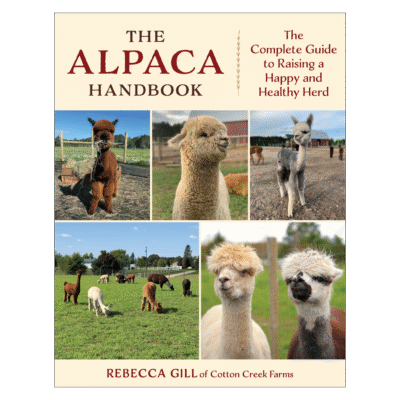
The Alpaca Handbook: Everything You Need to Raise Healthy and Happy Alpacas
If you've enjoyed this content, you'll love Rebecca's new book. The Alpaca Handbook is the essential guide to raising, breeding, and enjoying alpacas on the farm. The book is a great resource for alpaca owners who raise them for fun or profit. In this 17 chapter, 200+ page, full color book, you’ll learn everything you need to know to become a successful alpaca owner. Each chapter includes educational information, as well as stories that tie this information to real-world experiences.